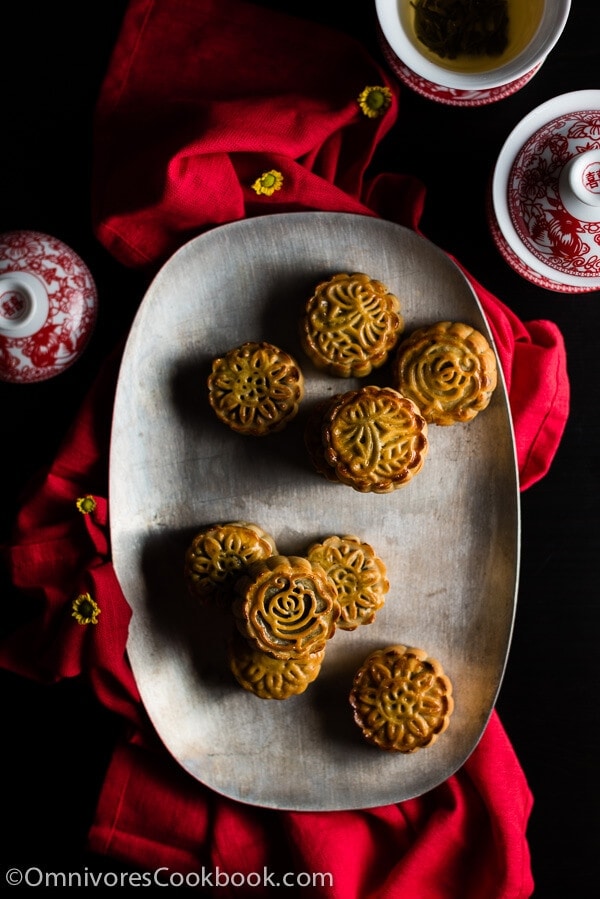
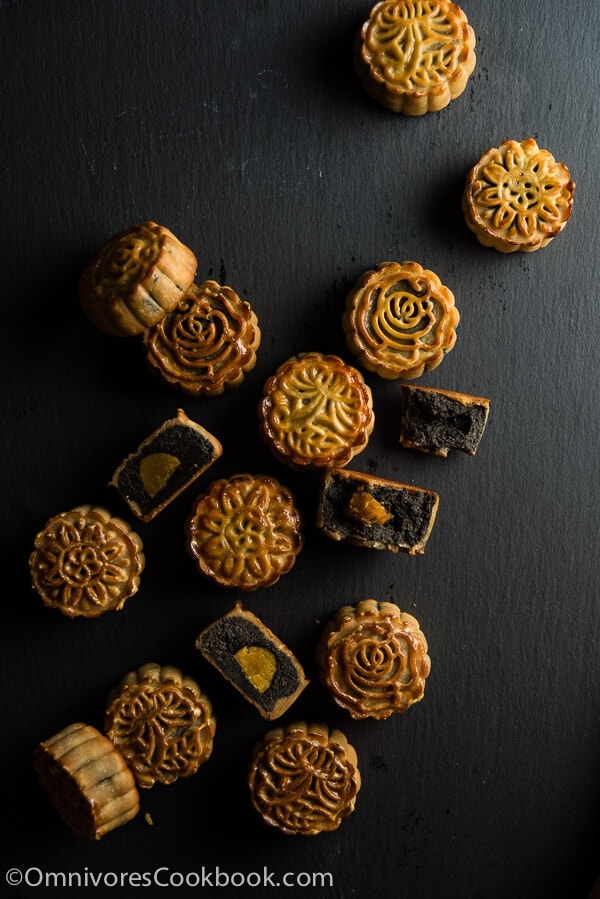
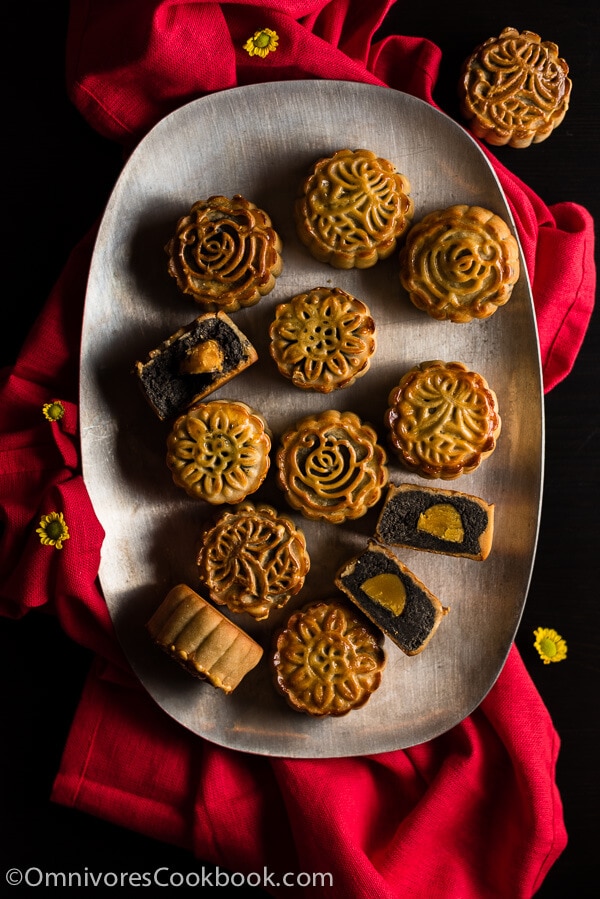
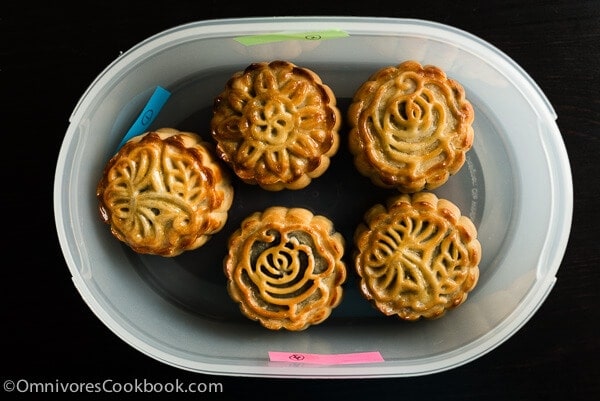
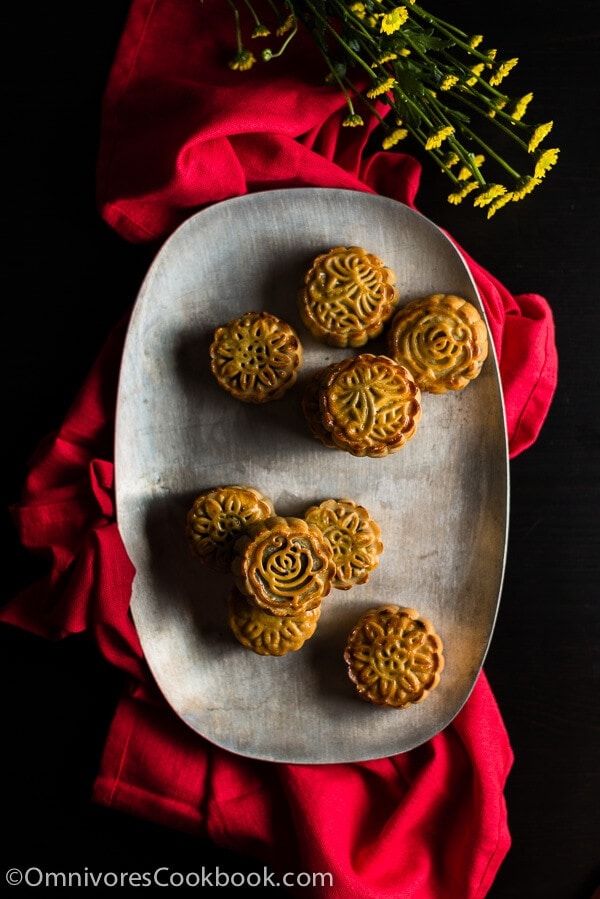
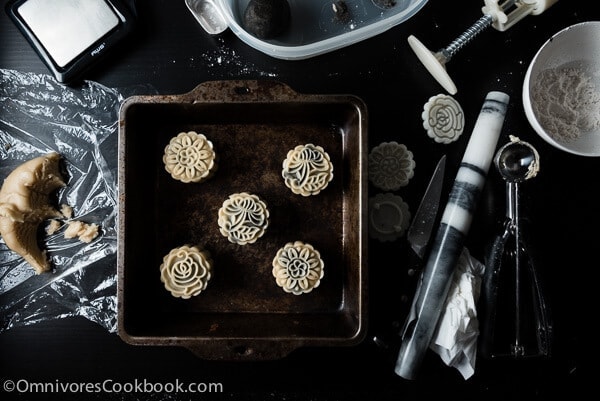
This recipe shows you how to create traditional Cantonese mooncakes from scratch without purchasing golden syrup or kansui. In this recipe, you get a delicious black sesame filling, a dough that has a good mouthfeel and keeps its shape, and thorough step-by-step pictures of the whole process. Moreover, I listed every tip and note I have, to help you make homemade mooncakes successfully. With this information, you’ll easily be able to adapt this recipe to the available ingredients you have, or whatever filling you prefer. {Long post alert} I tried to shorten it, but the post still ran very long (>4000 words), due to the sheer amount of information. If you don’t want to read the whole thing, be sure to browse the cooking notes before going to the recipe. You can also find more information about golden syrup and kansui in my other posts, and learn how to make them with typical household ingredients.
A bit about traditional mooncakes and why people don’t cook them at home
Mid-Autumn Festival is a big thing in China, and eating mooncakes with family members is a must. It’s the the 15th day of the 8th month of the lunar year – the middle day of autumn and the day of the full moon. It’s the day that family members sit together and enjoy mooncakes and a peaceful night with the brightest moon. You might wonder, do we cook mooncakes at home, just like we cook homemade dumplings to celebrate lunar new year? The answer is a big NO. Aside from the complicated cooking process and the fact that an oven is not commonly found in a Chinese kitchen, it’s simply because mooncakes are a very high-volume item. It’s a deep-rooted cultural tradition, where people send mooncakes to family and friends as a gift, starting two weeks before the festival. We get a big box of mooncakes from our employer, from our community center, from relatives and friends who bought too many boxes and can’t finish them. You see, a family can get so many boxes of mooncakes without spending a cent, and you probably only want to eat a few anyway (they’re too sweet and too heavy). The other fact is that traditional mooncakes are becoming less popular in China. There have been scandals, such as one where a mooncake company reused a stock of year-old mooncake filling and used gutter oil to cut costs. The other reason is that more modern styles of mooncake have become trendy, such as the snow skin mooncake (with a no-bake dough made from mochi) and French style mooncakes (made with French pastry dough and a jam-like filling). The third reason, and the most important one, is that the quality of traditional mooncakes has dropped significantly and they’re just not as tasty anymore. It has started to become superficial and cliche, as people only purchase them to give them away. It has become more standardized, less creative, and less fresh. When I told my mom that I finally made some great looking mooncakes, she was surprised and said “why bother? you don’t even like mooncakes.”
Mooncake obsession
The truth is, I did eat mooncakes back in China, but I only like the traditional kind with egg yolk in the filling. Not all mooncakes are filled with egg yolk. Most of the time, you only find one or two in a box of 12 mooncakes. And that is typically the single mooncake I eat each year. Unlike the miniature mooncakes you typically find in recipes online, the real mooncakes in China are huge. They use a minimal amount of dough so that the outside layer is paper thin, enclosing a giant, greasy, sweet block of filling that is usually made with tons of sugar and lard. It doesn’t sound very tasty, does it? The truth is that they can be very delicious if cooked properly with fresh ingredients. The reason I like the filling with egg yolk is that the savory yolk cuts the greasiness and sweetness of the rest of the mooncake. And the whole combination tastes like heaven. It is like sprinkling sea salt on caramel or adding a pinch of hot pepper into chocolate. You wonder why at first, but definitely GET IT once you taste it. I moved to Austin from China two months ago. While enjoying my new life in my new home, being spoiled with the variety of food options, I realized Mid-Autumn Festival was approaching and somehow I wanted to enjoy a traditional mooncake – one with egg yolk, of course.
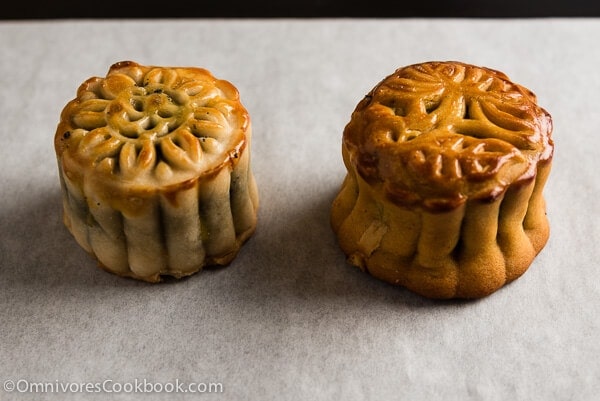
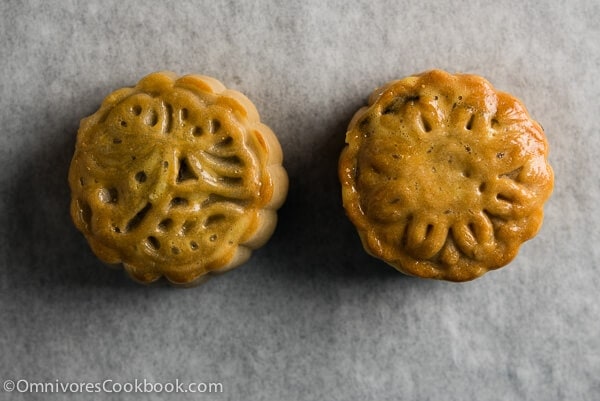
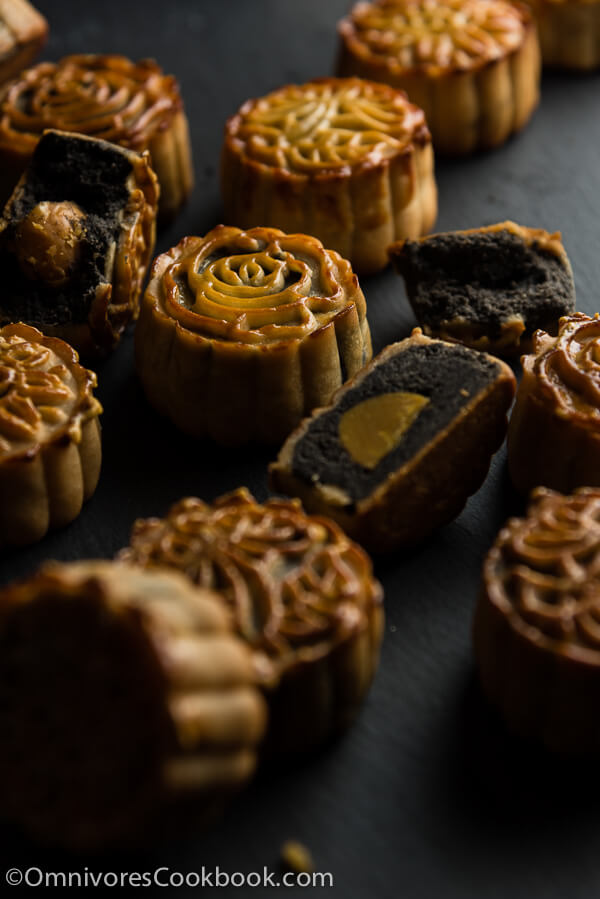
I made the decision that I’d make mooncakes a month ago, not knowing what I was getting myself into. The recipe development process was a difficult one. I believe I uttered “I want to kill myself” too many times during the past few days, which made Thomas very worried. We also ordered more pizza delivery than ever, because after spending so much time tweaking recipes and experimenting in the kitchen, we were too tired to cook dinner. I think I made more than ten batches, a small quantity per batch of course, until I lost count. While I was making the final batch to finish up this post, I was still baking them one at a time, to determine the best oven temperature and the perfect egg wash recipe. That’s why you can see that every mooncake in the photos looks slightly different. We ended our mooncake project yesterday with a bottle of champagne and two thick cuts of prime steak. Why go to so much trouble when there are literally hundreds of mooncake recipes online? The reason: I really wanted to find a way to make all the ingredients from scratch, to allow anyone who wants to make fresh mooncakes and enjoy Mid-Autumn Festival, regardless of access to an Asian store.
The difficulties
If you’ve ever checked a traditional mooncake recipe, you might have thought, what the hell are these ingredients? The truth is, among the four ingredients in mooncake dough, there are two – golden syrup and kansui, that you might have never heard of, and they can be difficult to acquire. A quick introduction, golden syrup is also called inverted sugar syrup. It is an amber-colored syrup made from sugar, but has a much richer texture and a deep aroma than a simple syrup. It also contains acid, which is a requirement for mooncake making. Kansui, jian sui in Chinese (枧水) or lye water, is an alkaline solution made from sodium carbonate and potassium carbonate. It is often used in Asian pastries and ramen noodles. It adds a yellow color to dough (like making egg noodles without egg). It acts a bit like baking soda, as it keeps the dough fluffy and moist, but without introducing too much gas. It also neutralizes the acid in the golden syrup, so the dough won’t taste sour. Most recipes suggest you purchase golden syrup online and purchase kansui in an Asian store. However, golden syrup is quite pricey and kansui is only available at large Asian markets. On the other hand, these two ingredients are very cheap and easy to acquire in China (although most Chinese people have never heard of them), so there is very limited literature on how to make them at home and how to use them in mooncake recipes. Mooncakes require very accurate measurements, and a single small tweak will change the results significantly. Say you follow a very precise recipe, one with ingredients measured in increments of one gram. Since there are different formulas of golden syrup and kansui, you could get different results than intended, even if you follow the recipe a hundred percent. During the mooncake-making process, it’s important to understand the function of each ingredient and the result it yields. You need to be accurate but also stay flexible when needed.
Why this recipe
I read many things online and did a lot of research around these two ingredients – golden syrup and kansui. I found that it’s possible to make these two rare ingredients at home with cheap and common ingredients. And it’s possible to cook mooncakes with them and get satisfying results. I have tested numerous recipes with both store-bought and homemade ingredients. I also tested the combination of store-bought and homemade. They all work and and can create delicious mooncakes. And now you can learn do the same, using this recipe. I picked a nutty black sesame filling and egg yolk as the mooncake filling for this recipe. It’s a classic, as well as my favorite. The sweet and nutty sesame paste is a delicacy and goes perfectly with the egg yolk. There are not so many recipes for it online (because most people buy the paste pre-made), so I developed it myself. It generates a paste with a silky texture and great flavor. It uses butter instead of lard, but the mooncake still holds its shape. It might sound like bragging, but I love the taste of these mooncakes; it’s even better than the mooncakes I’ve had in China. This recipe is just one possibility that I discovered along the way while cooking. It’s still far from perfect. However, I wanted to share all the things I’ve learned so far, so you could apply them, even if you use a totally different recipe in the future.
Cooking notes
Here are some cooking notes that I gathered from other sources and verified in my kitchen. Please note, not all the points are related to this recipe. I wanted to share them anyway, because you can use them to develop your own mooncake recipe. They can also help you troubleshoot a recipe if something goes wrong. Here we go.
About mooncake filling
The most important thing is that it keeps its shape and doesn’t collapse, so that the mooncake will maintain its delicate pattern after baking. No matter what type of filling you’re making, the filling should able to stand firm at room temperature right after being shaped into a ball. And it should turn tough after chilling in the fridge. (1) You need to introduce oil with a low melting point into the filling. Lard is a common ingredient in traditional mooncakes, but it might yield an unpleasant flavor. And it’s just greasy. I find that coconut oil and butter yield similar results. Only use coconut oil if the flavor combination works. The flavor of coconut oil doesn’t go well with everything. (2) You need add a certain amount of solid content so that the dough can stand firm, even at room temperature. I’ve seen people use different things, such as flour, bean paste, cornstarch, etc., to achieve this. On the other hand, if you add too much solid content, the filling will start to taste like dough. I found that glutinous rice flour works great in this case. It helps the filling to stick to itself, and you don’t really notice it while eating. Unrelated to this recipe, if you are making a red bean or lotus seed filling (or any filling that contains water), the other way to make a thicker filling is to cook the paste on the stove, to reduce water content. (3) You still need to add oil to the filling, even if the filling is tough by itself. The first reason is that the filling will be crumbly and fall apart without oil. The second is that traditional Cantonese mooncakes must be served 1 to 3 days after baking, because the mooncake skin will be very tough and crumbly right after baking. As the mooncakes rest, the oil inside them seeps out and infuses into the outer layer of dough. This way, the texture becomes soft and moist. Without oil in the filling, this important process doesn’t happen.
About mooncake dough
(1) Both all-purpose flour and cake flour work well. Traditional Cantonese mooncakes use cake flour, which is what is used in this recipe. It yields a very tender dough (easy to work with, but slightly sticky) that yields a beautiful pattern after baking. (2) The single thing that matters most is the ratio of golden syrup to kansui. The golden syrup will create a tender and moist cake that keeps its shape despite being paper thin, and can be shaped into delicate patterns. Kansui is used to neutralize the acid introduced by the golden syrup, resulting in a sweet pastry with no sourness. The amount of kansui also determines the tenderness and color of the cake. The color will be light yellow if you don’t add enough kansui, or dark brown if you add too much. The difficult thing is, unless you’re using exactly the same brand as given in a recipe, it’s unlikely that your cooking will yield the same results. If you’re looking for perfect mooncakes, you might need to try a few times to get everything perfect. On the other hand, even if the color or shape is slightly off, the mooncakes will taste just as delicious. (3) You can use homemade or store-bought golden syrup. Please note, the acid content will not be the same. This will affect the amount of kansui you need to use. You can read a bit more on the topic in this post. (4) You can use homemade or store-bought kansui. To make kansui at home, you only need baking soda and water . The two have slightly different contents, but yield very similar results. You can learn how to make kansui in this post. (5) How to adjust the dough. Since the ratio of kansui to golden syrup is fixed, you should not change their quantities (it’s unlikely you can change them both, due to the small quantity of kansui added in a recipe). When you follow a recipe and it turns out that the dough is too soft to work with or too tough to knead, you should only add oil or flour to adjust the consistency of the dough. (6) Thickness of the mooncake skin. The answer is, you should keep it thin, really thin. Otherwise, the decorative pattern won’t come out very clear, and the bottom of the cake will be fat. (7) Size of the mooncake. You don’t need to fill the whole mold (unless you’re using a traditional hand-carved mold). If you’re making mini mooncakes and use a plastic mold kit (the most common), a 50-55 gram cake is easy to shape. That equals about 2.5 tablespoons of filling plus 2 teaspoons of dough. (8) Egg wash. There are different theories on the perfect egg wash. I tested them, but only noticed subtle differences. My favorite way is to use egg yolk with a pinch of salt. The egg wash will be very thick and a bit difficult to apply, but it yields an even and beautiful golden color with a distinctive aroma. If you think this is too much trouble, beat a whole egg and use that instead. (9) Baking temperature. There are different theories about baking temperatures (from 350 to 390 F/ 176 to 200 C), but I found that all of them work. For making mini mooncakes, my favorite temperature is 360 degrees F (180 C). (10) The baking process includes two phases, no matter what temperature you use. The first phase usually takes 8 to 10 minutes. During this phase, the mooncake takes its shape and the dough hardens. You should see the edges of the mooncakes start to turn golden. Take out the mooncakes and apply egg wash only after the surface hardens. If you apply egg wash too early, it can easily ruin the pattern. For the second phase, return the mooncakes to the oven and continue baking until the surface turns dark golden. It usually takes another 8 to 11 minutes, depending on the oven temperature. (11) Let the mooncakes rest long enough to reveal their color and turn soft. Just as wine needs time to mature, you need to let mooncakes rest to get the best texture and flavor. Traditional Cantonese mooncakes typically need to rest 24 to 72 hours. The mooncakes will be very flaky and crumbly right after baking. They turn very hard as they cool down, and their texture will become soft and moist again after two to three days as the oil seeps out from the filling (this process is known as hui you – 回油).
About the tools
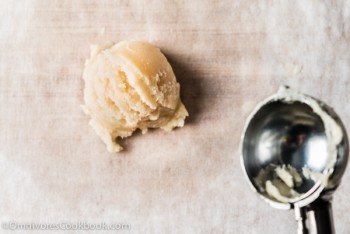
(1) You need a scale. Not only did I use a scale, I even purchased a pocket scale with increments of 0.1 gram. Because most Chinese recipes measure by the gram, I found that even a scale with increments of 1 gram is not accurate enough. When you’re making mooncake dough, if you are measuring by the cup, you really need some luck to get the to recipe work. Measurements matter a lot when it comes to mooncake making. (2) You need a brush, maybe two. I prefer to use a large silicone brush to apply the egg wash, because it allows a gentle touch and is easy to clean. After brushing the surface 3 to 4 times, I switch to a small pointed brush to clean out the gaps and remove excess egg wash. (3) A cookie scoop will save you a lot of trouble. I love the small and medium sized OXO cookie scoop. The small size holds 2 teaspoons and the medium size holds 1.5 tablespoons. They’re perfect for measuring the dough and filling. They shape the dough easily and speed up the measuring process.
Final thoughts
If you haven’t closed the page by the time you’ve read this far, I assume you’re very serious about mooncakes! I want to emphasize that there are many approaches when it comes to mooncake making. Although the process calls for accuracy and although it’s quite easy to mess things up during cooking, the mooncakes will turn out very tasty even if the pH is slightly off, or if you accidentally smash the pattern. Do not pursue perfection on the first attempt. This is just like making croissants. You need patience and practice to get there. I hope my post, along with the recipe below, provides you a more accessible path to mooncake making and makes the mooncake process less mysterious. Homemade mooncakes with fresh ingredients have such a nice aroma and flavor, and store-bought mooncakes just not can’t compete with them. Plus, they contain far fewer calories and use healthier ingredients. I hope you enjoy the dish and have a happy Mid-Autumn Festival!
Want to learn more about Chinese Cooking? Sign up my newsletter to receive the 5-Day Chinese Cooking Crash Course and recipe update!
Related recipes
Homemade Golden Syrup Homemade Kansui How to make Lotus Seed Paste (for mooncake) Homemade Red Bean Paste
!